I don't get over to survivalblog very often anymore. They were the first to post any of my writing and for that I will forever be grateful. It kick started this blog and my writing at other avenues and some more "seditionist" pages I've penned for. I try to keep it on an even keel here, but it's a very well known fact that I believe, and have believed for the past 20+ years that Her Highness Killary is the devil incarnate. If you believe the way I do and expect to see a civil war if she becomes president, read this article in its entirety.
https://survivalblog.com/madame-clintons-coming-war-on-the-blogosphere-and-your-countermeasures/
I have a plan. I've done the research. Many of the things on this have already been done my me, including buying prepaid phones 700+ miles from my AO with cash. Clean operations equipment, clean infomatics, clean pseudonyms with street cred are helpful.
I've been blessed to have made the acquaintance of many who have worked within the government leviathan. It's truly amazing what they will talk about when you shut up and listen. Equipment capabilities, standard procedures, contract personnel requirements, maintenance intervals, team tactics, observation capabilities and most importantly, who they look for. The above post at survivalblog will help you realize your exposure to action. Be aware and ever vigilant.

Showing posts with label Bug out. Show all posts
Showing posts with label Bug out. Show all posts
Tuesday, August 9, 2016

Sunday, July 31, 2016
Clothing for the Apocalypse!
I know it's silly to post sensationalism like this, but with people posting all these stupid things about pokemon and politics, I just can't help myself! Seriously though, this is an important part of your life and times.
Everyone has a favorite pair of shorts, pants, shirt, shoes and (especially important) underwear. Sometimes it's purely emotional, like that lucky pair of drawers you were wearing that time you met that double jointed Swedish stewardess! Or not. My favorites all come due to comfort and/or usefulness. It's really important to have functional clothing at your disposal when the chips are down or you have to switch gears quickly. Case in point
Everyone has a favorite pair of shorts, pants, shirt, shoes and (especially important) underwear. Sometimes it's purely emotional, like that lucky pair of drawers you were wearing that time you met that double jointed Swedish stewardess! Or not. My favorites all come due to comfort and/or usefulness. It's really important to have functional clothing at your disposal when the chips are down or you have to switch gears quickly. Case in point
Sunday, March 27, 2016
Spring Break Woodcrafting Trip.
The boys and I are all loaded up for a trip to the woods. We have set goals, some a bit too lofty, but they are a solid plan. I showed my eldest manchild how to strike fire from a ferro rod with fatwood and the youngest is going to forego a shelter and make one of his own design to sleep in. The eldest is responsible for the fire for the week. Should be interesting, for sure!
 We went over the meal plan, the camp site, the sleeping arrangements as well as crafts we intend to accomplish while there. Should be a fun trip. I'll be getting some pics to use for some upcoming reviews and might even get some video footage if it gets really boring. I hope everyone has a safe Easter and can enjoy spring break!

Wednesday, March 23, 2016
Trained Agents of Doom
Many post apocalyptic books contain some sort of "Goon Squad" that seeks to destroy the hero and leave the public in disarray. Some have the goons be trained, others have them as inept thugs. Either way you slice this poop sandwich, it's going to stink. Is this a realistic scenario? From reading blow by blow details from war torn and folded countries like Liberia, Congo and Venezuela, we can begin to see what happens in a power vacuum or war torn area. Factions will exist, they will become territorial and only lash out when cornered or forced to by dwindling supplies.
The trained and motivated aren't going to be your first priority. It's the desperate and hungry that will be thrust upon your property looking for supplies, if things devolve to that level. Your best bet it to stay anonymous. Keep yourself as innocuous as possible. Grey man all the time, without drawing any attention to yourself or your actions.
Buying bulk items at non commercial stores will get you noticed. Same with getting a pallet of food delivered to your home. Your neighbors will notice. If you don't have a basement, build shelves near the ceiling of your garage to house your stores so that people driving by can't see 20 food buckets piled about.
If you have disregarded all thoughts of remaining anonymous and have decided to advertise your abilities and discontent, you will need to have a method of early warning and detection for your adversaries. I'm not going to go into the specifics, but you will need a few minutes notice that the boogey man is coming.
A trained and determined enemy will do surveillance on you and yours in order to find your vulnerabilities. If they find that you have minimal security or personnel, they may opt to just execute you from long range to keep their exposure to danger low. Counter surveillance will be key in that situation. That art takes people and time, so make sure you have trained trackers to interdict outside assets. Drone technology is another issue to deal with. Modern drones can house sophisticated optics and infrared technology to track your outpost.
The moral of the story is that it's easier to remain hidden than it is to protect a known target. Due diligence staying hidden will be much easier than expecting a fight.
The trained and motivated aren't going to be your first priority. It's the desperate and hungry that will be thrust upon your property looking for supplies, if things devolve to that level. Your best bet it to stay anonymous. Keep yourself as innocuous as possible. Grey man all the time, without drawing any attention to yourself or your actions.
Buying bulk items at non commercial stores will get you noticed. Same with getting a pallet of food delivered to your home. Your neighbors will notice. If you don't have a basement, build shelves near the ceiling of your garage to house your stores so that people driving by can't see 20 food buckets piled about.
If you have disregarded all thoughts of remaining anonymous and have decided to advertise your abilities and discontent, you will need to have a method of early warning and detection for your adversaries. I'm not going to go into the specifics, but you will need a few minutes notice that the boogey man is coming.
A trained and determined enemy will do surveillance on you and yours in order to find your vulnerabilities. If they find that you have minimal security or personnel, they may opt to just execute you from long range to keep their exposure to danger low. Counter surveillance will be key in that situation. That art takes people and time, so make sure you have trained trackers to interdict outside assets. Drone technology is another issue to deal with. Modern drones can house sophisticated optics and infrared technology to track your outpost.
The moral of the story is that it's easier to remain hidden than it is to protect a known target. Due diligence staying hidden will be much easier than expecting a fight.
Sunday, November 1, 2015
Gear Review: Portable Backpacking/Emergency Survival Stoves
This one has been in the works for a long time. I've been striving to find the easiest way to heat meals and water for years. The idea is very simple, by the subjectivity of the requirements makes the issue a hard one to crack. Modern Survivalists and recreational backpackers alike have some of the same needs, but the sustainability issue is many order of magnitudes greater for the preparedness minded. We also have to consider the usage for more than one person. In order to properly evaluate stoves for these uses, we must first consider the criteria to be used.

1. Heating ability- This is how quickly it heats and/or how much heat the stove is able to produce.
2. Flexibility- Does the stove offer options to make it more useful?
3. Economy -Is the stove efficient and inexpensive?
4. Fuel availability- Does the fuel store well and/or easily acquired?
5. User friendly- Is it too heavy, too dirty, too hard to use, easily stored, etc?
Using this index, we should be able to get a better picture of what types of stoves are best and adequate for each need. I have every main type of stove available. I'm sure there are different models that do better or worse than the models I'm using, but for this purpose, it will work just fine. I'm not going to be ultra scientific, but I will be working the units as well as possible. Different fuels require different methods and measurements as well.

My first real camp stove was the Primus Omnifuel. This is a monster of a stove. You can use just about any combustible out there to run it. You may need to change nozzles (provided) and take some time to warm it up, but once it gets going, it puts out a ton of flame and even more noise. This is by far the heaviest and most powerful stove I own. If you purchase extra adapters, you can use old Coleman style propane cylinders or even an LP tank like on a gas grill. This is the most flexible stove as well with it's fuel usage and with accessories, you can even hang it from a ridge line or tree. When I say combustible fuels, I mean anything that *might* burn if coaxed properly. I've even had success with vegetable oil, but it required significant heating in order to get it to atomize in the heating block. The listed fuels are gasoline and white gasoline, diesel fuel, isobutane, butane, and kerosene. Kerosene and home heating oil are very similar, so you can use either. For a grid down scenario, this one would be my choice for the best stove you could hope to own. Heating ability 4/5, it by far puts out the most heat, but it needs constant tinkering to keep the flame regulated. The flame can be uneven as well. Flexibility 5/5, This thing is as flexible as a stove can possibly be. Economy 3/5, The unit retails at 150 bucks, and if you add in all the accessories, you are up over 200. Also, fuel costs money. Initial investment is the biggest holdback on this item. Fuel Availability 4/5, As long as you have a liquid that burns or a propane/isobutane cylinder with fuel, you are good to go. User Friendly 3/5, It's a very good, useful unit, but the flexibility comes with the price of cleaning and maintaining the unit. It can be messy and it stinks if you are burning heavy fuels. It's loud as all get out. You can barely speak to someone next to you if you are cooking with a liquid fuel. Another issue is that the manufacturer recommends not using commercial auto fuel due to issues with additives being toxic.
Total score 19. Total Time to heat 2 cups of tap water to a rolling boil- 3:16 minutes using White Gas.
The MSR Pocket Rocket is a very sturdy stainless backpacking stove. This unit puts out the best flame of any backpacking stove I've used. It beats the jetboil and classic stoves I've used in the past. It is extremely rugged and has good regulation ability for multiple cooking uses. It's very nice for keeping water of coffee warm without having to turn it off and back on all the time. The flame can be set very low and still burn true. It's not the lightest unit I own, and it requires a manual start, but other than that it's a good unit. Heating ability 4/5, it heats well and is big enough to fry large pans and not worry about the outside edges not getting done. Decently even flame. Flexibility 2/5, These are only made to work with Isobutane backpacking fuel cells. You can convert it to LP, but it's not as hot is you do. Economy 3/5, it's not expensive and the fuel cells are 6 bucks or so a pop. Not a huge investment unless you plan to use it long term and need 100's of fuel cells. Fuel availability 2/5, these fuel cells are by far the hardest to find at a non specialized retail outlet. User Friendly 5/5, This is the easiest, most reliable way to cook.
Total score 16. Time to heat 2 cups of tap water to a rolling boil- 3:05 on full blast with a waning cylinder. Might go faster with a full cylinder.
Trangia Spirit Stove's have been around a long time. These are used in Europe by some military forces. They are a durable alcohol stove that allows you to keep unused fuel inside the unit. Most alcohol stoves must be left to burn the excess off and then stored. It's an easier but heavier alcohol than some of the bigger names, but this one is a bit more reliable and user friendly. It heats slower than the pressurized stoves in the comparison, but it's reliable unless you are in a significant wind. The best fuel is denatured alcohol. It's not as stinky as Methyl alcohol (yellow HEET) and burns just as well. There are other alcohols you can use but you must be careful, many are toxic if you happen to spill them into your food. Grain alcohol is a non toxic alternative. Heating ability 2/5, depending on the fuel used, it can do a great job heating your food or water. It's not the best flame dispersion, but more than adequate for most duties if you're not in a time pinch. It is non adjustable. Flexibility 3/5, It requires a stable flat (ish) surface to work correctly. A few fuels are available. Economy 4/5, These things are super cheap, as is the fuel. They use very little fuel at a time. Fuel availability 3/5, In a grid down situation you can find some type of fuel left behind when all the gas and diesel or LP is all gone. You can even make your own Grain alcohol if you want to be really wasteful. User Friendly 2/5, This type of stove has a narrow use that works well for backpackers, but is relegated to emergency use for survivalists. It's slow to start and messy until you get good with it. It really needs a pot holder and wind guard to be viable under most conditions.
Total score 15. Time to boil 2 cups of tap water to a rolling boil- 13:41 minutes using denatured alcohol. Heet brand Methyl Alcohol heats slightly faster but stinks horribly.
Esbit Hexamine solid fuel stoves have been used in one form or another for decades in the US military. The fuel is solid blocks of stable burning cubes that look like salt. They are easy to light and can be blown out so you can partially burn the cube if desired. The knockoff brands usually use oval or round shapes. Genuine Esbit is square and has score marks on the larger blocks if you choose to cut them up for a smaller or shorter burn. These stoves are made in many configurations by many manufacturers, but the folding Esbit seems to be the favored by most people. This type of stove is great for long term storage and needs very little coaxing to get it lit. The biggest draw back is, they stink to high heaven. They also leave an oily caked on residue on your pots or pans. The cubes are as reliable as a rock. It takes a serious rain to put them out! My favorite use is to throw one in the kindling to start a fire. It's a sure thing! Heating ability 3/5, They put out an extremely reliable amount of heat. They are not adjustable once lit, but you can make them smaller for less heat or add cubes for more heat. Flexibility 2/5, They only work with Hexamine tablets by a few manufacturers. Not many stores carry them unless they have a significant camping department. Once you're out of tablets, it's a smelly coaster to rest your drink on. Economy 5/5, These things are cheap. You can even make one out of a tin can if you want. The fuel cubes are cheap as well. I can heat 24 meals for 4 bucks worth of tablets and have a few left over for coffee. Fuel availability 2/5, You can get them at Wally world, but they often run out and I have to get them from Amazon. A few different manufacturers make them, like 4 total, so it's a crap shoot when you find them at a retail store. User Friendly 2/5, The biggest issue I have is the smell and the stinky residue. Once I'm done cooking, I'm not all that hungry. They light easily and work well, but have significant draw back for regular use.
Total score 14. Time to boil 2 cups of tap water to a rolling boil- 8:46 minutes using Esbit tabs. Coghlan tabs take longer and will use 2 tabs for the same duration.

Wood gasifier stoves have been around for centuries. They can be readily made out of a few tin cans and a pocket knife. They work on the principle that injecting heated air into the smoke of a flame will cause a hotter and more useful flame with less waste. Smoke is wasted fuel from the combustion process. You can test this by holding a lighter in the smoke near a fire to see it in action. There are a few different models as well. My favorite model being the TOAKS titanium wood gas stove. There are cheaper commercial options all the way down to 24 bucks, but that TOAKS is light weight and small when broken down. The combustion process is the same with all these top load units. They have an inner burn tray with holes at the bottom to allow an updraft into the base of the stove and an outside liner that traps hot air between the inner and outer walls of the stove. Air is super heated inside the walls and is pushed into the burn chamber at the top to allow extra oxygen into the burn chamber for a cleaner and hotter burn. This makes for a low smoke fire once you get it going. It's obvious when it's operating properly, the air flowing into the chamber from inside the walls looks similar to a gas grill flame minus the blue tint. The main drawback to this type of stove is the constant stoking and feeding you must keep up with in order for the unit to operate at a constant temperature. The cheaper 24 dollar stainless option from Amazon is quite hard to feed. If you use a larger pan, you must remove the pan to feed it. You can use just about anything that will burn in this stove. dry weeds, grass, nuts, bark, cardboard, esbit cubes, paper, etc. Once lit, it will burn hot for a while. If you get a good coal bed going, you can use it as a warmer to keep your food warm for literally hours. It was still warm when I picked it up after 3 hours of smouldering. I used it to warm up some applewood chips for the smoker. I like to boil them if I can't soak them overnight. It kept them warm enough I had to use a scoop to put them in the smoker even after 2 hours post boil. Heating ability 4/5, You can adjust the flame easily by blowing or stoking the flame and well as relying on wood choice for heat quality. Flexibility 4/5, You can use it for many different uses and have similar results. Economy 5/5, The cheapo units sell at 24 dollars with the high end Titanium units going for 100. The big draw here is you can reliably fire it with dead fallen branches for no cost. You can baton firewood and really get it going hot for an extended period. Fuel availability 5/5, you can use anything that burns, for free. Even dried animal poop will fire right up. User friendly 2/5, this is the big drawback for this unit. It takes time to get running, requires the greatest amount of time to get lit, and needs constant attention. You must use care where you set it to keep embers from starting fires as they fall through the bottom and it's not very stealthy due to the smoke it gives off unit it's hot.
Total Score 21. Time to boil 2 cups of tap water to a rolling boil- 6:28 minutes. I used dry sycamore and lit the wood with some small strips of cardboard. It took approximately 5 minutes to get the wood burning before setting the pot on the stove.
In conclusion, you must choose wisely based on your needs and the stove's strengths. There are a few I didn't go over, but they are fringe items that require too much space in a pack or require direct sunlight like with a solar oven. These systems are fairly useless when you consider the drawbacks. Small rocket stoves work almost identically to the top load wood gas stoves. I see no reason to cover them considering the duplicity.
The plan I have chosen is to keep my Omnifuel with my long term food storage, complete with several gallons of White gas. It's a very good option for off the grid use once the grill tanks I've stored give out. It's small size and flexibility are well suited to mobile camping or a shelter in place ordeal. The wood gas stove will go into the emergency evacuation bag. It's well suited to long term sustainability without a resupply. The Isobutane or Alcohol stoves sit in my recreational packs, they are perfectly suited for such use. The Esbit stoves are spread out in Cache's, assault packs and travel packs. Their light weight and long term storage ability are perfect for such use.

1. Heating ability- This is how quickly it heats and/or how much heat the stove is able to produce.
2. Flexibility- Does the stove offer options to make it more useful?
3. Economy -Is the stove efficient and inexpensive?
4. Fuel availability- Does the fuel store well and/or easily acquired?
5. User friendly- Is it too heavy, too dirty, too hard to use, easily stored, etc?
Using this index, we should be able to get a better picture of what types of stoves are best and adequate for each need. I have every main type of stove available. I'm sure there are different models that do better or worse than the models I'm using, but for this purpose, it will work just fine. I'm not going to be ultra scientific, but I will be working the units as well as possible. Different fuels require different methods and measurements as well.

My first real camp stove was the Primus Omnifuel. This is a monster of a stove. You can use just about any combustible out there to run it. You may need to change nozzles (provided) and take some time to warm it up, but once it gets going, it puts out a ton of flame and even more noise. This is by far the heaviest and most powerful stove I own. If you purchase extra adapters, you can use old Coleman style propane cylinders or even an LP tank like on a gas grill. This is the most flexible stove as well with it's fuel usage and with accessories, you can even hang it from a ridge line or tree. When I say combustible fuels, I mean anything that *might* burn if coaxed properly. I've even had success with vegetable oil, but it required significant heating in order to get it to atomize in the heating block. The listed fuels are gasoline and white gasoline, diesel fuel, isobutane, butane, and kerosene. Kerosene and home heating oil are very similar, so you can use either. For a grid down scenario, this one would be my choice for the best stove you could hope to own. Heating ability 4/5, it by far puts out the most heat, but it needs constant tinkering to keep the flame regulated. The flame can be uneven as well. Flexibility 5/5, This thing is as flexible as a stove can possibly be. Economy 3/5, The unit retails at 150 bucks, and if you add in all the accessories, you are up over 200. Also, fuel costs money. Initial investment is the biggest holdback on this item. Fuel Availability 4/5, As long as you have a liquid that burns or a propane/isobutane cylinder with fuel, you are good to go. User Friendly 3/5, It's a very good, useful unit, but the flexibility comes with the price of cleaning and maintaining the unit. It can be messy and it stinks if you are burning heavy fuels. It's loud as all get out. You can barely speak to someone next to you if you are cooking with a liquid fuel. Another issue is that the manufacturer recommends not using commercial auto fuel due to issues with additives being toxic.
Total score 19. Total Time to heat 2 cups of tap water to a rolling boil- 3:16 minutes using White Gas.
The MSR Pocket Rocket is a very sturdy stainless backpacking stove. This unit puts out the best flame of any backpacking stove I've used. It beats the jetboil and classic stoves I've used in the past. It is extremely rugged and has good regulation ability for multiple cooking uses. It's very nice for keeping water of coffee warm without having to turn it off and back on all the time. The flame can be set very low and still burn true. It's not the lightest unit I own, and it requires a manual start, but other than that it's a good unit. Heating ability 4/5, it heats well and is big enough to fry large pans and not worry about the outside edges not getting done. Decently even flame. Flexibility 2/5, These are only made to work with Isobutane backpacking fuel cells. You can convert it to LP, but it's not as hot is you do. Economy 3/5, it's not expensive and the fuel cells are 6 bucks or so a pop. Not a huge investment unless you plan to use it long term and need 100's of fuel cells. Fuel availability 2/5, these fuel cells are by far the hardest to find at a non specialized retail outlet. User Friendly 5/5, This is the easiest, most reliable way to cook.
Total score 16. Time to heat 2 cups of tap water to a rolling boil- 3:05 on full blast with a waning cylinder. Might go faster with a full cylinder.
Trangia Spirit Stove's have been around a long time. These are used in Europe by some military forces. They are a durable alcohol stove that allows you to keep unused fuel inside the unit. Most alcohol stoves must be left to burn the excess off and then stored. It's an easier but heavier alcohol than some of the bigger names, but this one is a bit more reliable and user friendly. It heats slower than the pressurized stoves in the comparison, but it's reliable unless you are in a significant wind. The best fuel is denatured alcohol. It's not as stinky as Methyl alcohol (yellow HEET) and burns just as well. There are other alcohols you can use but you must be careful, many are toxic if you happen to spill them into your food. Grain alcohol is a non toxic alternative. Heating ability 2/5, depending on the fuel used, it can do a great job heating your food or water. It's not the best flame dispersion, but more than adequate for most duties if you're not in a time pinch. It is non adjustable. Flexibility 3/5, It requires a stable flat (ish) surface to work correctly. A few fuels are available. Economy 4/5, These things are super cheap, as is the fuel. They use very little fuel at a time. Fuel availability 3/5, In a grid down situation you can find some type of fuel left behind when all the gas and diesel or LP is all gone. You can even make your own Grain alcohol if you want to be really wasteful. User Friendly 2/5, This type of stove has a narrow use that works well for backpackers, but is relegated to emergency use for survivalists. It's slow to start and messy until you get good with it. It really needs a pot holder and wind guard to be viable under most conditions.
Total score 15. Time to boil 2 cups of tap water to a rolling boil- 13:41 minutes using denatured alcohol. Heet brand Methyl Alcohol heats slightly faster but stinks horribly.
Esbit Hexamine solid fuel stoves have been used in one form or another for decades in the US military. The fuel is solid blocks of stable burning cubes that look like salt. They are easy to light and can be blown out so you can partially burn the cube if desired. The knockoff brands usually use oval or round shapes. Genuine Esbit is square and has score marks on the larger blocks if you choose to cut them up for a smaller or shorter burn. These stoves are made in many configurations by many manufacturers, but the folding Esbit seems to be the favored by most people. This type of stove is great for long term storage and needs very little coaxing to get it lit. The biggest draw back is, they stink to high heaven. They also leave an oily caked on residue on your pots or pans. The cubes are as reliable as a rock. It takes a serious rain to put them out! My favorite use is to throw one in the kindling to start a fire. It's a sure thing! Heating ability 3/5, They put out an extremely reliable amount of heat. They are not adjustable once lit, but you can make them smaller for less heat or add cubes for more heat. Flexibility 2/5, They only work with Hexamine tablets by a few manufacturers. Not many stores carry them unless they have a significant camping department. Once you're out of tablets, it's a smelly coaster to rest your drink on. Economy 5/5, These things are cheap. You can even make one out of a tin can if you want. The fuel cubes are cheap as well. I can heat 24 meals for 4 bucks worth of tablets and have a few left over for coffee. Fuel availability 2/5, You can get them at Wally world, but they often run out and I have to get them from Amazon. A few different manufacturers make them, like 4 total, so it's a crap shoot when you find them at a retail store. User Friendly 2/5, The biggest issue I have is the smell and the stinky residue. Once I'm done cooking, I'm not all that hungry. They light easily and work well, but have significant draw back for regular use.
Total score 14. Time to boil 2 cups of tap water to a rolling boil- 8:46 minutes using Esbit tabs. Coghlan tabs take longer and will use 2 tabs for the same duration.

Wood gasifier stoves have been around for centuries. They can be readily made out of a few tin cans and a pocket knife. They work on the principle that injecting heated air into the smoke of a flame will cause a hotter and more useful flame with less waste. Smoke is wasted fuel from the combustion process. You can test this by holding a lighter in the smoke near a fire to see it in action. There are a few different models as well. My favorite model being the TOAKS titanium wood gas stove. There are cheaper commercial options all the way down to 24 bucks, but that TOAKS is light weight and small when broken down. The combustion process is the same with all these top load units. They have an inner burn tray with holes at the bottom to allow an updraft into the base of the stove and an outside liner that traps hot air between the inner and outer walls of the stove. Air is super heated inside the walls and is pushed into the burn chamber at the top to allow extra oxygen into the burn chamber for a cleaner and hotter burn. This makes for a low smoke fire once you get it going. It's obvious when it's operating properly, the air flowing into the chamber from inside the walls looks similar to a gas grill flame minus the blue tint. The main drawback to this type of stove is the constant stoking and feeding you must keep up with in order for the unit to operate at a constant temperature. The cheaper 24 dollar stainless option from Amazon is quite hard to feed. If you use a larger pan, you must remove the pan to feed it. You can use just about anything that will burn in this stove. dry weeds, grass, nuts, bark, cardboard, esbit cubes, paper, etc. Once lit, it will burn hot for a while. If you get a good coal bed going, you can use it as a warmer to keep your food warm for literally hours. It was still warm when I picked it up after 3 hours of smouldering. I used it to warm up some applewood chips for the smoker. I like to boil them if I can't soak them overnight. It kept them warm enough I had to use a scoop to put them in the smoker even after 2 hours post boil. Heating ability 4/5, You can adjust the flame easily by blowing or stoking the flame and well as relying on wood choice for heat quality. Flexibility 4/5, You can use it for many different uses and have similar results. Economy 5/5, The cheapo units sell at 24 dollars with the high end Titanium units going for 100. The big draw here is you can reliably fire it with dead fallen branches for no cost. You can baton firewood and really get it going hot for an extended period. Fuel availability 5/5, you can use anything that burns, for free. Even dried animal poop will fire right up. User friendly 2/5, this is the big drawback for this unit. It takes time to get running, requires the greatest amount of time to get lit, and needs constant attention. You must use care where you set it to keep embers from starting fires as they fall through the bottom and it's not very stealthy due to the smoke it gives off unit it's hot.
Total Score 21. Time to boil 2 cups of tap water to a rolling boil- 6:28 minutes. I used dry sycamore and lit the wood with some small strips of cardboard. It took approximately 5 minutes to get the wood burning before setting the pot on the stove.
In conclusion, you must choose wisely based on your needs and the stove's strengths. There are a few I didn't go over, but they are fringe items that require too much space in a pack or require direct sunlight like with a solar oven. These systems are fairly useless when you consider the drawbacks. Small rocket stoves work almost identically to the top load wood gas stoves. I see no reason to cover them considering the duplicity.
The plan I have chosen is to keep my Omnifuel with my long term food storage, complete with several gallons of White gas. It's a very good option for off the grid use once the grill tanks I've stored give out. It's small size and flexibility are well suited to mobile camping or a shelter in place ordeal. The wood gas stove will go into the emergency evacuation bag. It's well suited to long term sustainability without a resupply. The Isobutane or Alcohol stoves sit in my recreational packs, they are perfectly suited for such use. The Esbit stoves are spread out in Cache's, assault packs and travel packs. Their light weight and long term storage ability are perfect for such use.
Sunday, October 18, 2015
Budget AR15 Builds and Why I Choose Them.
It's well know that I prefer the AR platform to any other battle rifle. The reasons are due to it's proliferation in the US as well as my familiarity with the rifle series. It's the most common rifle sold in the US for a long time now and it really is well suited to 90% of shooters due to it's modular and adjustable nature. You can build them in literally any configuration imaginable.
 Most recent build. My son built the entire thing himself at 12 years old. It now has a Black Spider red dot.
Another significant belief I have was first iterated by good old Joe Stalin. "Quantity has a quality all it's own." So for the price of a high end manufacturer's AR15, I can build 3 budget guns. Once again, why? Because even a budget build can work remarkably well. Outfitting another person can be more of a force multiplier than a super whiz bang piston driven death dealer.
These builds tend to run around the 650 dollar mark and include a 1x optic. Why an optic? Because it's a crutch. Teaching fundamentals with irons take time, and it's much easier and faster to teach fundamental hold and bullet drop.You might not be outfitting a shooter, you might be outfitting a neighbor.
 The Minuteman Cache includes such a rifle.
What to look for in a budget rifle:
Standard quality parts
Mil spec dimension parts
For this discussion, there are some built rifles that accomplish these tasks. Smith and Wesson's base models as well as DPMS's base models work just fine. I haven't had much luck with PSA or some of the other cheapo parts like UTG and the like. Double star on the other hand have been nothing short of brilliant in my rifles. Many contractors are given DPMS rifles for ship defense and foreign protection details. They work and they're cheap. I've been using the DPMS oracle uppers for all the builds I've done in the past 4 years with a perfect track record. No functionality issues, decent accuracy and a cost around 300 bucks. Hard to beat with an included BCG and charging handle.
Optics are an easy choice. Something inexpensive and durable. Vortex is a good option for this. The Sparc series is pretty good, and there are a myriad of others out there that will work great. Always have extra batteries on hand. I include flip up iron sights as well. I've been prone to getting a gas block with a picatinny rail and dual flip ups die to wanting a clear sight picture. A standard front sight post occludes your sight picture.

I generally install a JP reduced power spring kit to loosen up the trigger a bit. A cheapo sling works great, and it is easy because the rifles I build are very light weight.

Another significant belief I have was first iterated by good old Joe Stalin. "Quantity has a quality all it's own." So for the price of a high end manufacturer's AR15, I can build 3 budget guns. Once again, why? Because even a budget build can work remarkably well. Outfitting another person can be more of a force multiplier than a super whiz bang piston driven death dealer.
These builds tend to run around the 650 dollar mark and include a 1x optic. Why an optic? Because it's a crutch. Teaching fundamentals with irons take time, and it's much easier and faster to teach fundamental hold and bullet drop.You might not be outfitting a shooter, you might be outfitting a neighbor.

What to look for in a budget rifle:
Standard quality parts
Mil spec dimension parts
For this discussion, there are some built rifles that accomplish these tasks. Smith and Wesson's base models as well as DPMS's base models work just fine. I haven't had much luck with PSA or some of the other cheapo parts like UTG and the like. Double star on the other hand have been nothing short of brilliant in my rifles. Many contractors are given DPMS rifles for ship defense and foreign protection details. They work and they're cheap. I've been using the DPMS oracle uppers for all the builds I've done in the past 4 years with a perfect track record. No functionality issues, decent accuracy and a cost around 300 bucks. Hard to beat with an included BCG and charging handle.
Optics are an easy choice. Something inexpensive and durable. Vortex is a good option for this. The Sparc series is pretty good, and there are a myriad of others out there that will work great. Always have extra batteries on hand. I include flip up iron sights as well. I've been prone to getting a gas block with a picatinny rail and dual flip ups die to wanting a clear sight picture. A standard front sight post occludes your sight picture.

I generally install a JP reduced power spring kit to loosen up the trigger a bit. A cheapo sling works great, and it is easy because the rifles I build are very light weight.
Saturday, September 5, 2015
Gear Review: Osprey Aether 70 gen 4 Backpack
With my boys old enough to start backpacking and really getting into it, I've been eyeing a few of the higher end packs out there. I've used crappy rucks for so long that I'm used to getting sore shoulders and abrasions on my collar bone area after day 2. Now that I'm a bit older and can afford a better pack, the options are endless. My quest started online, looking at backpacking blogs, trail blogs, manufacturer sites and REI. There were so many options that I was a bit bewildered.I've been on a lightweight backpacking kick for a while so I looked at many lightweight bags but decided to buy a big multipurpose bag instead. Nothing heavy, but big enough and tough enough to take on a winter trip for a few days.
The next thing I did was to measure up all the gear I would take and get it together to see what size pack I needed. It seemed like 65 liters without food is enough for a good winter trip, so I looked at maybe 80 liters with a nice heavy bag and extra clothes would be optimal. After looking around and checking out the packs I spotted that fit my needs, I decided that a 65 or 70 liter pack would fit just fine. My lead choices were the REI crestrail 70, Arc'teryx ultra 65, North Face Terra 65, Granite Gear Blaze and the Osprey Aether 70.
The Osprey had the largest capacity, the Granite gear was the lightest, the Arc'teryx was the toughest material and the REI was a good blend of all the others. I didn't choose the Arcteryx due to it's hip system being a bit too lightweight for such a big bag. I dropped the Granite Gear because it's just not stable enough for me with an HDPE frame. I chose the Osprey due to it's stellar customer service reputation and the well built suspension system.

With 50+ nights of camping over 2 years and backpacking "in the bag" so to speak, it's been a very good, serviceable bag. The price is very commensurate with the quality. Even after stuffing this thing to the gills for a 3 night trip in weather down to 10 degrees. I've hiked several double digit days with it while hosting scouts and with my family out in rough terrain. Once you get the belts set for you, it's a simple task to get up and go.
The bag is a single cavity system with a lower adjustable divider. The divider is perfect for someone who changes out their sleep system routinely. In the summer I use a fleece liner. It's good down to 50 degrees or so in the hammock. If I pack properly, I can fit my entire summer sleep system minus the pad into the lower cavity of the pack. The pack has a zipper at the lower end for removing your sleeping bag without removing the gear from the top.
The top cover is also a single cavity unit. That can be frustrating at times, but once you ziplock bag things up it gets easier. Everything on the pack is industry standard, side compression straps, cinch top for the main pack, side and back elastic pockets, wire backplate and padded straps. Some different things you will find on the pack are double keepers on the front straps, pole keepers on the front and back, side pockets and a stiff moldable hip belt, a separate pocket for a hydration system, and a built in whistle on the chest strap. The area that is against your back is very comfortable without getting too hot. Air channels pump air along your back with every step. The pack's frame is adjustable to fit many different torso lengths.

The pack has been extremely durable. I've bushwacked through briers, fallen into rocks, had mice in it and stuffed it to it's breaking point. There isn't a single tear, rip, hole or abrasion on the pack. It had a thick base material that keeps it from getting holes when you set it down. My youngest dragged the pack on my concrete driveway for 30 feet before I stopped him. No marks. The zippers works like the day I received it. It's never hitched up or had to be reset.

The good: Comfortable. rugged for it's weight, good zippers and buckles, bottom and side feeding as well as top feeding, adjustable.
The bad: Rather heavy for the size, topper is single cavity, side pockets are a bit small.
The ugly: None.
I'll post up my full kit at another time.
The next thing I did was to measure up all the gear I would take and get it together to see what size pack I needed. It seemed like 65 liters without food is enough for a good winter trip, so I looked at maybe 80 liters with a nice heavy bag and extra clothes would be optimal. After looking around and checking out the packs I spotted that fit my needs, I decided that a 65 or 70 liter pack would fit just fine. My lead choices were the REI crestrail 70, Arc'teryx ultra 65, North Face Terra 65, Granite Gear Blaze and the Osprey Aether 70.
The Osprey had the largest capacity, the Granite gear was the lightest, the Arc'teryx was the toughest material and the REI was a good blend of all the others. I didn't choose the Arcteryx due to it's hip system being a bit too lightweight for such a big bag. I dropped the Granite Gear because it's just not stable enough for me with an HDPE frame. I chose the Osprey due to it's stellar customer service reputation and the well built suspension system.

With 50+ nights of camping over 2 years and backpacking "in the bag" so to speak, it's been a very good, serviceable bag. The price is very commensurate with the quality. Even after stuffing this thing to the gills for a 3 night trip in weather down to 10 degrees. I've hiked several double digit days with it while hosting scouts and with my family out in rough terrain. Once you get the belts set for you, it's a simple task to get up and go.
The bag is a single cavity system with a lower adjustable divider. The divider is perfect for someone who changes out their sleep system routinely. In the summer I use a fleece liner. It's good down to 50 degrees or so in the hammock. If I pack properly, I can fit my entire summer sleep system minus the pad into the lower cavity of the pack. The pack has a zipper at the lower end for removing your sleeping bag without removing the gear from the top.
The top cover is also a single cavity unit. That can be frustrating at times, but once you ziplock bag things up it gets easier. Everything on the pack is industry standard, side compression straps, cinch top for the main pack, side and back elastic pockets, wire backplate and padded straps. Some different things you will find on the pack are double keepers on the front straps, pole keepers on the front and back, side pockets and a stiff moldable hip belt, a separate pocket for a hydration system, and a built in whistle on the chest strap. The area that is against your back is very comfortable without getting too hot. Air channels pump air along your back with every step. The pack's frame is adjustable to fit many different torso lengths.

The pack has been extremely durable. I've bushwacked through briers, fallen into rocks, had mice in it and stuffed it to it's breaking point. There isn't a single tear, rip, hole or abrasion on the pack. It had a thick base material that keeps it from getting holes when you set it down. My youngest dragged the pack on my concrete driveway for 30 feet before I stopped him. No marks. The zippers works like the day I received it. It's never hitched up or had to be reset.

The good: Comfortable. rugged for it's weight, good zippers and buckles, bottom and side feeding as well as top feeding, adjustable.
The bad: Rather heavy for the size, topper is single cavity, side pockets are a bit small.
The ugly: None.
I'll post up my full kit at another time.
Thursday, February 5, 2015
Minuteman Cache Example, Cache #2
We've talked a bit about Cache locations Here and Here on the Total Survivalist Blog, as well as at the Tblog Here. Now let's talk about a minimum baseline of equipment. One should have a minimum of each necessary item to successfully survive in a hostile location. Think of what would want in a certain situation and backtrack from there. I've built a cache for several of the most dire situations. Let's look at the choices I've made and use those situations to backtrack to the kit I would need.
Natural disaster:
Basic needs like clothing, important documents, shelter, money, some food, minimum weaponry, comfort items for sensitive persons, camera, limited comms, anything you might need to sort out the situation. In my area, there are 3 major issues I might have to contend with. Tornadoes, earthquakes and flooding. Flooding is the least of these worries for me. Every house I've ever purchased has been in the highest area of the surrounding few miles. At my current location, the water would have to be 60 feet over flood stage to bother my crawl space. That would be a biblical flood. Even the 100 year flood we had in my area didn't flood anything but the entrance to my neighborhood with a foot of water. Earthquakes happen in my area, but they are generally mild and without serious damage. I keep my stores in the corner of my home away from the second story as a precaution. Tornadoes are an entirely different animal. I live at the end of Tornado alley in the central midwest. The area around me has been peppered with F1-F3 twisters for years. Being that my home is elevated, it's a prime candidate for serious damage. The tornado threat generally moves southwest to northeast and rarely deviates from that pattern. This rule makes it best for my Cache to be within hiking distance to my northwest or southeast. My current disaster kit is 4.3 miles away, due north. That area isn't known to be hit with tornadoes due to it's lower level and protection to it's due west with hills and valleys. Picture below was taken near my place of business after an F3 hit, it took me 3 hours to get home.

Governmental Oppression/Revolution- Grey man kit- To be posted this week.
Total Bugout- My first tier equipment, bugout trailer and everyone's gear. Post Next week
Hide out-Civilian camping setup- Post next week
Hide out- Bubba gear! Post in the spring.
Insurrection/Riots/Social Upheaval: Cache #2 of this type.
This kit is going to be weapons and comms heavy. You will want to either fit in with the rioters, or be able to put them down if threatened. Luckily, one of my insurrection Caches happens to be home for an update and to keep it at home until the construction is done at it's usual resting place. I keep 2 cases (A/B Menu) of MRE's there as well, but I'm not worried about those getting pinched. I also have a set of camos hanging in his closet to go with this kit. The homeowner is a sportsman, but has no decent kit as a fighting loadout. This kit is set up for many uses as well. It has the basic requirements to go fight at a moments notice. All you would have to do is load some mags and get busy. I built this kit from the equipment I started with when I first got into the survivalist lifesytle.
Overview:
The container is a super heavy duty tote you can get at Lowes for 11-15 bucks. I have several and they are awesome. It's secured by wrapping a 6' cable lock through the holes in the lid and bin. These are pretty bomb proof and will take a decent hit even in cold weather without breaking. I tested them the best way possible. I bought one and donated it to the scouts I work with. They didn't break it on a -10 degree camping trip, so it's pretty darn solid.


.
Chest rig partially unloaded- Glock 22 with TLR-1 with condor holster, 15rnd mag(loaded), 4- 17 round mags and 2-22 rnd mags(unloaded), 7 USGI ar mags(unloaded), Micro tool and mini flashlight, The mesh pocket in back has a topo map of my AO and the AO the kit is in. I purchased this chest rig just for this kit. It's not something I would want to use for more than a limited time.
 The backpack: LA police gear 3 day pack, (In depth review Here) by compartment. Top is a TAG 6 mag carrier full of empty GI mags. Lower front compartment is a food prep compartment, fuel tabs, lightweight stove, cliff bars, more mountain house and backpackers pantry meals, salt and pepper, tobasco, TP that's been vacuum sealed flat, salt and pepper, water tabs and a couple lighters. Caffiene pills and coffee and tea are in there somewhere, never leave home without it. Will be adding some chocolate and sugar to it while it's here.


Lower add on butt pack: Tarp, Tactical bandana in OD, Poncho, gloves, GI belt. This has extra room for stripped MREs.

Main Compartment:Light sticks, Paper and pencils, cash, cordage, Otis cleaning kit, Camo Backpacking tent, Jungle bag and liner, Stainless container, aluminum cup, socks, washcloth, solar charger for AA, AAA and CR123 batteries, Spare Batteries. Adding more batteries, ESS eye pro, ear pro and a cash bought disposable phone.

Side pouch 1: Ammo on stripper clips. Once loaded, this pouch will be for stripped MRE's

Side Pouch 2: EDC belt and IWB holster for the Glock in case I need to fit in for a bit. Pouch doubles as MRE holder as well.
 What it's missing- A good first aid kit with trauma gear. My EDC bag has that and I should have it with me. Clothes aren't included. I should have some in the kit but it's not meant for me as a primary so I didn't include any.A water bladder needs to be installed in this system. It's the only unit I have without one.
Estimated worth of this kit is right at 3000 bucks, about 1k less than what the rifle in my first line kit costs. It's a (relatively) inexpensive option to kit out a friendly or as a last ditch kit up location in case of a serious breach in your preparedness design. It's NOT enough by itself to get me to my alternate location.
More to follow soon!
Natural disaster:
Basic needs like clothing, important documents, shelter, money, some food, minimum weaponry, comfort items for sensitive persons, camera, limited comms, anything you might need to sort out the situation. In my area, there are 3 major issues I might have to contend with. Tornadoes, earthquakes and flooding. Flooding is the least of these worries for me. Every house I've ever purchased has been in the highest area of the surrounding few miles. At my current location, the water would have to be 60 feet over flood stage to bother my crawl space. That would be a biblical flood. Even the 100 year flood we had in my area didn't flood anything but the entrance to my neighborhood with a foot of water. Earthquakes happen in my area, but they are generally mild and without serious damage. I keep my stores in the corner of my home away from the second story as a precaution. Tornadoes are an entirely different animal. I live at the end of Tornado alley in the central midwest. The area around me has been peppered with F1-F3 twisters for years. Being that my home is elevated, it's a prime candidate for serious damage. The tornado threat generally moves southwest to northeast and rarely deviates from that pattern. This rule makes it best for my Cache to be within hiking distance to my northwest or southeast. My current disaster kit is 4.3 miles away, due north. That area isn't known to be hit with tornadoes due to it's lower level and protection to it's due west with hills and valleys. Picture below was taken near my place of business after an F3 hit, it took me 3 hours to get home.
Governmental Oppression/Revolution- Grey man kit- To be posted this week.
Total Bugout- My first tier equipment, bugout trailer and everyone's gear. Post Next week
Hide out-Civilian camping setup- Post next week
Hide out- Bubba gear! Post in the spring.
Insurrection/Riots/Social Upheaval: Cache #2 of this type.
This kit is going to be weapons and comms heavy. You will want to either fit in with the rioters, or be able to put them down if threatened. Luckily, one of my insurrection Caches happens to be home for an update and to keep it at home until the construction is done at it's usual resting place. I keep 2 cases (A/B Menu) of MRE's there as well, but I'm not worried about those getting pinched. I also have a set of camos hanging in his closet to go with this kit. The homeowner is a sportsman, but has no decent kit as a fighting loadout. This kit is set up for many uses as well. It has the basic requirements to go fight at a moments notice. All you would have to do is load some mags and get busy. I built this kit from the equipment I started with when I first got into the survivalist lifesytle.
Overview:
The container is a super heavy duty tote you can get at Lowes for 11-15 bucks. I have several and they are awesome. It's secured by wrapping a 6' cable lock through the holes in the lid and bin. These are pretty bomb proof and will take a decent hit even in cold weather without breaking. I tested them the best way possible. I bought one and donated it to the scouts I work with. They didn't break it on a -10 degree camping trip, so it's pretty darn solid.
Everything out of the box:AR15 by bushmaster with a
lightweight DPMS upper and a full mag of TAP ammo, vortex RDS, Cheapo BUIS with Trijicon front sight insert, Hogue grip with insert
that has extra batteries for the RDS, Midway Sling, Quickie MH food, chest rig by
condor, Beofeng radio-programmed for local tower and Em. services, Ammo
boxes-federal and ZQI, Hornady critical duty 40 SW ammo.
.
Chest rig partially unloaded- Glock 22 with TLR-1 with condor holster, 15rnd mag(loaded), 4- 17 round mags and 2-22 rnd mags(unloaded), 7 USGI ar mags(unloaded), Micro tool and mini flashlight, The mesh pocket in back has a topo map of my AO and the AO the kit is in. I purchased this chest rig just for this kit. It's not something I would want to use for more than a limited time.
Upper compartment: Snivel kit, Deodorant, soap, toothbrush, toothpaste, light stick, headlamp, fishing line for perimeter traps, head net for bugs, matches, large multitool, 100% DEET spray, Frog Lube, toothpicks, Adding a cover (hat) and some trash bags and gorilla tape to it while it's here.
Main Compartment:Light sticks, Paper and pencils, cash, cordage, Otis cleaning kit, Camo Backpacking tent, Jungle bag and liner, Stainless container, aluminum cup, socks, washcloth, solar charger for AA, AAA and CR123 batteries, Spare Batteries. Adding more batteries, ESS eye pro, ear pro and a cash bought disposable phone.
Side pouch 1: Ammo on stripper clips. Once loaded, this pouch will be for stripped MRE's
Side Pouch 2: EDC belt and IWB holster for the Glock in case I need to fit in for a bit. Pouch doubles as MRE holder as well.
Estimated worth of this kit is right at 3000 bucks, about 1k less than what the rifle in my first line kit costs. It's a (relatively) inexpensive option to kit out a friendly or as a last ditch kit up location in case of a serious breach in your preparedness design. It's NOT enough by itself to get me to my alternate location.
More to follow soon!
Saturday, February 1, 2014
Wifey's 3 Day pack.

I'm in the process of building a 3 day pack for the wife to take in her vehicle. There are so many threads out there on how to build one for a man or kids, we don't hear much about the contents of a woman's BOB. Women are hardy and able to deal with much more than we think, but they also can wilt pretty quickly without some semblance of civilized products or regular items.
Let's look at it from the perspective of a problem solver. How far (Realistically) will she have to travel? How far can she walk in a day? Will she have companions? Can she travel safely? Is she trained or mentally ready for a sudden tedious walk? What will make it easier for her?
Then we get into the essentials for her trip, including the math for how long her trip will be. It's all math at that point. Let's use my wife as an example. She's a remote employee for a 3 letter mega corporation and travels to local clients only rarely. Usually she's too far away to rescue, or she's here at home. Recently she's been in Dearborn, MI consulting for another mega corporation that sports 4 letters. If she's that far away, I can't help her because she's out of reach. Not only that, the pack won't be coming on the plane with her so it's moot. If she's at a local client's place, she can make it home within 3 days at most. About 35 to 40 miles max. She can do 15 miles a day without issue as long as she's not running for her life or injured.
What will she need to make it 3 days on her feet in this weather? The lighter the pack, the faster the trip, plain and simple.
Pack- decent 3 day pack or daypack.
Shelter- Something to keep the rain off you while you rest or sleep.
Water- A way to get clean drinking water.
Food- Anything light, low salt and high calorie.
Light- Lightweight light source
Protection- Something to fend off Dogs or two legged animals.
Comms- Some way to contact home as far away as possible
Route- Find your way home without getting lost
Clothing- Weather appropriate gear
Personal items- Stuff you want and might need to have around.
Pack- It's usually best to figure this out last, because you want a pack big enough to fit everything you need. I have a few extra 3 day assault packs and some duffel bags, but for Christmas a few years ago I got her a really nice Kelty Backpack, a Redtail 30. It's really close to the size she needs, but it's a bright color. I'll decide once I'm ready to get the pack together. I have a feeling a black NC Star 3 day pack is in her future.
Shelter- The simpler the better. A tarp, casualty blanket or best of all, a Poncho would be perfect. It allows for protection without occluding your surroundings too much.
Water- I'm going to put a nalgene bottle and 2-20 oz water bottles in the pack in case my boys are with her. She will also get a bottle of purification tabs.
Food- Clif bars, some hard candy, some jerky sticks and trail mix.
Light- A small headlamp, extra batteries and maybe an extra flashlight. Preference given to a headlamp with a red beam for discreet travel at night.
Protection- This is where it gets screwy. She likes guns but isn't interested in carrying a gun so doesn't want to go get her carry license. That means in order to stay legal she needs a long gun. The obvious choice would be a KelTec Sub 2000 in 9mm. Breaks down to pack size, will take 33 round glock mags, and is easy to manipulate. 100 rounds JHP in 3 mags, 19 in an extended mag to keep in it. A decent sling will help too.

Comms- Cell Phone as primary and then a 2 way GMRS radios with extra batteries in case I can go look for her. All call signs and codes in a small notebook in the pack. Radio is set to proper channel and privacy code before hand. We have tested them and they are good to 4 miles if at least one person is elevated. If the phone lines are a mess, texts should still work as long as the towers are still operating. Another option is a backup disposable cell phone in case of a domestic threat.
Route- Pre planned routes from each side of the larger, meaner city close by, as well as from each direction of travel from home. A map and compass will be in the pack, with a rain cover or ziplock bag. Routes Marked in highlighter close to home but not all the way. Maybe to the edge of where she knows the streets well.
Clothing- Army Surplus silk thermals, a few pairs of warm non cotton socks, a warm hat, rain suit if no poncho, a loose fitting warmup or track suit. My wife is well endowed, no reason to entice the animals. She always wears a warm jacket and I'll throw and gloves and a scarf inside the hat. Another hugely important item is shoes. Find a pair that she doesn't wear because they look too shabby and put those in the pack. She won't miss them and they will be well broken in. Think Grey Man Camo. Have her dress as average as possible and remove all jewelry.
Personal Items- TP, Wet Wipes, Tampons (There's a 1 in 5 chance she will need them), Nail clippers, a small knife, Zip ties, Gorilla tape wrapped around a shopping card, Paracord in case she needs to repair clothing or breaks a shoestring, a small microfiber towel. Anything that's small and light that will help her. Maybe a lighter and some Votive candles in case she needs a fire for an emergency, like if she fell in some water and was too cold to continue on without drying off. First aid kit with plenty of Ibuprofen. Some cash in medium and small bills would help as well. Keep them in different places in case the pack gets grabbed.

Things to make sure she leaves out of the pack:
Earbuds- They will ruin her ability to observe her surroundings.
High salt food- It can cause a person to dehydrate and get cramps
Alcohol- No reason to make a person sleep deeper than need be or have dulled senses.
Loud toys for the kids- obvious attention getters.
Brightly colored clothes- Think grey.
Purse- Have her throw everything in the pack, dirtbags know purses mean money.
Should she ever need to use it, the earlier she heads out, the safer she will be. If she's in denial and shelters in place, it's going to get more difficult. We live near a major city and many of the companies she visits aren't in the best part of town. Her most often visited client is in the middle of a large industrial/urban complex of factories, scrap yards and has a major interstate and a large river between her and the house. The Interstate only has 3 places to pass under it that she could reliably use without adding a day to her trip. There are 2 river crossings under the interstate, but they aren't passable.

Without a plan, the proper mindset, and the tools to succeed, any venture you attempt can be more difficult than it needs to be. I love my wife dearly and would want her to make it home if there's an emergency. I know many of us always think of ourselves and how we would make it home, but what about the rest of the family? It's only fair to make sure they can have the same or even a better chance than you do.
Wednesday, January 29, 2014
Gear Review: LA Police Gear 3day pack
About two years ago I bought an inexpensive 3day sized pack from LA police gear for 29.99 plus shipping. http://www.lapolicegear.com/diplomat-3-day-backpack1.html I expected it to be a thin, cheapo bag for stuffing extra gear in. What I received was a very durable material backpack with good stitching and thick padded straps. I looked the unit over very well and decided to utilize it as a primary unit, retiring the light weight pack I've grown out of.
I decided to do some research on the pack before I invested the energy to personalize it. I found widely varying reviews and opinions on the pack so I was adamant about deciding for myself. Upon the first evaluation, I was still undecided due to the cut and bulk of the pack. At first the zippers were very hard to operate and caught on the lining very easily. Once broken in, the bag sculpted to my back and the zippers became far more user friendly. The first addition I made the the pack was a 102oz water beast bladder system from Camelbak. It fit perfectly and even came in OD like the pack I chose. As I've added equipment and accessory pouches all over it to make an extended sustainment pack. This brought it's capabilities from 3 days to a month or so fairly quickly. The molle system made adding the pouches very easy. The pack itself full loaded weighs in at 36 pounds before water is added to the bladder.
The interior of the pack has a pvc coating making the pack water resistant. The external compression straps make it easy to attach a bed roll, rope or backpacking tent. I've also added a tomahawk to the exterior compression strap. Instead of buying a ready made system that you have to deal with how it's made, this system allows for easy customization. The drink tube can be routed left or right due to the pack having 2 gusseted outlet tabs with hook and loop closures. I haven't tried rucking the unit for extended days, but it works great and is fairly comfortable for a weekend pack trip. I usually use it for car camping trips and extended range trips where it would take 3 or more days to walk home.
Overall, the pack gets 2 thumbs up. One for being fairly inexpensive and one for being robust for it's price. I'm not saying this unit is equal to anything made by Blackhawk, Eagle, Maxpedition or other name brands. The packs strength is it's price. It doesn't have the best zippers or hook and loop. It doesn't have a name brand's warranty or backing. I've kept this pack loaded for almost 2 years now and I've car camped, hiked, rendezvous, and bugged out with this pack on numerous occasions. There isn't a single rip, tear, hole, zipper issue or even a worn strap. Solid performance at a budget price. The only reason I'm changing is so I can have a modular sleep system in my pack during winter and to have a better suspension system.
Let's take a look at mine:

I've added a Condor extra large bottom pouch that was made to be a stand alone satchel. A few Blackhawk pouches of different types, a Condor Tool carrier pouch and smaller flashlight/admin pouch on the front. Each pouch has it's purpose. Food, first aid, hygiene, Pens and paper, tools and such. The outside Molle webbing has held up tremendously well. Not a single stitch has come loose, nor has a zipper had to be reset. It's holding together my menagerie of pouches like a champ!
The modular nature of the pack allows me to customize the setup depending on what I'm planning. I can attach my shotgun scabbard to the side and now I have a pack hunting rig! Another couple additions I made are a SOG tactical tomahawk in a custom made kydex sheath and Blackhawk TaTang knife in a custom sheath.

 The pack has been complete for about 6 months now, so I guess it's time to replace it with something designed to do what I'm forcing this pack to do and return this pack to a 3 day pack and pass it on to my son.
Here's what the pack holds right now, minus food. I keep a small food bag prepped and ready for a hasty exit. I can lash it to my pack in a second so the food isn't in there right now.
 Gear list:
8x12 tarp, heavy duty tent stakes, Skeeter Beeter Hammock, Precut tarp lines, Sleeping bag, Rope, Cook pots and stove kit, rain gear, dopp kit, mess kit, Stainless mug, tea/coffee/juice kit, playing cards, Med kit, sam splint and shears,Katadyn hiker pro filter, Poncho and garbage bags, shemaugh, hat, gloves, wet wipes, zip ties and gorilla tape, head net, microfiber towel, paracord, notebook with info and codes, Night ize figure 9's, writing utensils, mirror, tools, inner tube ranger bands, P51, Blackhawk TaTang knife, SOG tomahawk, 12v solar charger, AA/AAA charger, CR123 charger, assorted batteries, chem lites, headlamp, backup battery charger for technology, bladder, map case and compass, GPS, water hose, yoyo fishing kit.
I used to add a pad and 2 man tent under the compression straps when it was cold out, but they are in the trailer and it's freezing cold outside. Not gonna go get them right now. I did notice a few things have come up missing over time. My spare socks are missing, as are the clothes pins I keep in there. Huh, must have needed them elsewhere.
I'll make sure to post a review of my recreational pack, and Osprey Aether 70, when I get a chance. The new Bugout pack, a Marine ILBE and assault pack, will also be coming up for review.
I decided to do some research on the pack before I invested the energy to personalize it. I found widely varying reviews and opinions on the pack so I was adamant about deciding for myself. Upon the first evaluation, I was still undecided due to the cut and bulk of the pack. At first the zippers were very hard to operate and caught on the lining very easily. Once broken in, the bag sculpted to my back and the zippers became far more user friendly. The first addition I made the the pack was a 102oz water beast bladder system from Camelbak. It fit perfectly and even came in OD like the pack I chose. As I've added equipment and accessory pouches all over it to make an extended sustainment pack. This brought it's capabilities from 3 days to a month or so fairly quickly. The molle system made adding the pouches very easy. The pack itself full loaded weighs in at 36 pounds before water is added to the bladder.
The interior of the pack has a pvc coating making the pack water resistant. The external compression straps make it easy to attach a bed roll, rope or backpacking tent. I've also added a tomahawk to the exterior compression strap. Instead of buying a ready made system that you have to deal with how it's made, this system allows for easy customization. The drink tube can be routed left or right due to the pack having 2 gusseted outlet tabs with hook and loop closures. I haven't tried rucking the unit for extended days, but it works great and is fairly comfortable for a weekend pack trip. I usually use it for car camping trips and extended range trips where it would take 3 or more days to walk home.
Overall, the pack gets 2 thumbs up. One for being fairly inexpensive and one for being robust for it's price. I'm not saying this unit is equal to anything made by Blackhawk, Eagle, Maxpedition or other name brands. The packs strength is it's price. It doesn't have the best zippers or hook and loop. It doesn't have a name brand's warranty or backing. I've kept this pack loaded for almost 2 years now and I've car camped, hiked, rendezvous, and bugged out with this pack on numerous occasions. There isn't a single rip, tear, hole, zipper issue or even a worn strap. Solid performance at a budget price. The only reason I'm changing is so I can have a modular sleep system in my pack during winter and to have a better suspension system.
Let's take a look at mine:
I've added a Condor extra large bottom pouch that was made to be a stand alone satchel. A few Blackhawk pouches of different types, a Condor Tool carrier pouch and smaller flashlight/admin pouch on the front. Each pouch has it's purpose. Food, first aid, hygiene, Pens and paper, tools and such. The outside Molle webbing has held up tremendously well. Not a single stitch has come loose, nor has a zipper had to be reset. It's holding together my menagerie of pouches like a champ!
The modular nature of the pack allows me to customize the setup depending on what I'm planning. I can attach my shotgun scabbard to the side and now I have a pack hunting rig! Another couple additions I made are a SOG tactical tomahawk in a custom made kydex sheath and Blackhawk TaTang knife in a custom sheath.
Here's what the pack holds right now, minus food. I keep a small food bag prepped and ready for a hasty exit. I can lash it to my pack in a second so the food isn't in there right now.
8x12 tarp, heavy duty tent stakes, Skeeter Beeter Hammock, Precut tarp lines, Sleeping bag, Rope, Cook pots and stove kit, rain gear, dopp kit, mess kit, Stainless mug, tea/coffee/juice kit, playing cards, Med kit, sam splint and shears,Katadyn hiker pro filter, Poncho and garbage bags, shemaugh, hat, gloves, wet wipes, zip ties and gorilla tape, head net, microfiber towel, paracord, notebook with info and codes, Night ize figure 9's, writing utensils, mirror, tools, inner tube ranger bands, P51, Blackhawk TaTang knife, SOG tomahawk, 12v solar charger, AA/AAA charger, CR123 charger, assorted batteries, chem lites, headlamp, backup battery charger for technology, bladder, map case and compass, GPS, water hose, yoyo fishing kit.
I used to add a pad and 2 man tent under the compression straps when it was cold out, but they are in the trailer and it's freezing cold outside. Not gonna go get them right now. I did notice a few things have come up missing over time. My spare socks are missing, as are the clothes pins I keep in there. Huh, must have needed them elsewhere.
I'll make sure to post a review of my recreational pack, and Osprey Aether 70, when I get a chance. The new Bugout pack, a Marine ILBE and assault pack, will also be coming up for review.
Tuesday, November 19, 2013
James Yeager's Bug Out
I don't normally push the sites or blogs of others, but for this one I will. The Tactical Response Guru has made a recent video set on youtube that goes over his kit, his ideas and his use of the kit, with a complete after action report. I will say that the entire thing was fairly well done. JamesYeager Channel
He went out for 24 hours and documented how bad life sucked when you make poor choices, he also allowed others to guide his bad choices by listening to the comments on his Youtube channel. As with any digital media, the internet ninjas came out in full force and spewed pathfinder school doctrine as well as the ideas of "experts" from the blog world. I'm sure a million people told him he'd die if he didn't take a metal water container.
There are a bunch of people out there who think he's an asshole. You're right, he is. That's part of his appeal in the mindset. He is Mr. Anti Establishment and is proud to be politically incorrect. Some of his training is spot on, some I disagree with. I guess that's why he has me blocked on Facebook! So do many other anti 2A groups, but he's the first Pro 2A blocking so I must be doing something right. If people can't debate you, they block you! All that aside, I personally know people who have taken his classes and raved about how much fun they were, how hard it was and how much they learned. That's a good sign, maybe I'll go and take a class with him sometime, maybe not.
In his first video, he has a very small, adequate pack for summertime ops in a small area of operation (AO). The pack I use is a bit smaller than the one he's showing, but is a side slung type with a hidden gun compartment. Inside his pack is a mess of stuff he plans to test and make due with. None of it looks well thought out, nor does it seem to make a complete system for a person trying to cover a limited area with a minimum number of items. Some of the stuff is for testing alone, but there is a ton of it and not much of it was tested after the terrain, poor pack choice, and a poor choice of footwear kicked his butt.
Go watch for yourself and you'll see some questionable choices and some sage advice for planning. I guess that's why it bothered me so much. He's a sharp guy, he knows better than to go out with untested gear and expect optimal results. The look on his face after one of his stops says it all. The "This Sucks" is written on his forhead! He admitted to choosing the wrong pack, it wasn't a cohesive system and that was it's biggest flaw.
As far as his chosen items go, he talked about not setting up a camp in a true emergency, but he chose to this time to test gear, I get that. That choice really screwed up his system because he had to carry items he wouldn't normally use in an emergency travel situation. The test was skewed from the get go. In an appropriate situation, I'm sure James would have a proper kit for the job, but in this "Test" case, in was a total cluster.It was successful because of his determination and grit, but it sucked much worse than it needed to.
Now, I'm not nearly the expert he is, but I'd have done the entire process in a totally different manner. First off, an A to B travel in an emergency situation isn't going to be stealthy because of the fall leaves. You're not going to be able to operate with impunity and have control over an area unless you have a large number of people in your group, which would preclude any need for an Emergency Evac. Since you can't be stealthy, you better look as innocuous as possible. Carrying a chest rig and an AK makes you a threat, and without rule of law, a threat is to be eliminated.
What does that mean? It means that commercial backpacking gear, or even a simple backpack is both simple and useful. It makes you look less tactical, less of a threat. Most commercial gear is lighter and more practical to begin with, so why not enjoy it?
My choice of gear for a short travel situation is pretty simple. I carry a kit in my vehicle for this very purpose. It's very small so it will fit underneath my seats. It's primary purpose is a med kit, so the med kit inside is pretty extensive. The secondary function is as a travel bag. I can choose to utilize it with a slung Remmy 870 that's also a regular part of the vehicle load. The equipment list is:
Optics planet OPMOD sling pack in OD Green
ITS Tactical universal velcro holster
Glock 26 with Clip draw and Saf-T-Block installed
2 spare mags
Med kit
2-20oz water bottles
4 Cliff bars
Medical shears (I replaced the black and red set with OD set)
Small pocket knife
Splint
Kleenex
sanitizer
Beofeng 5u radio with 14" upright and earpiece
Water tabs
tourniquet in holder outside the bag
collapsible baton
notepad and pen
flashlight, spare bulb and batteries
zip ties
mini lighter
cordage
Pick set
casualty tarp
solar blanket
gloves
ranger bands
gorilla tape
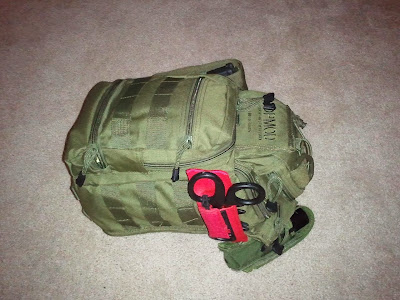
If I were planning to sleep on the way, as in a multi day excursion, I would have to use a larger pack for sleeping gear. 50 liters or better.
As far as layered clothes, I'd wear my normal layers for comfort. For shoes it would be either my Brooks Cascadia 8's or Merrill hiking shoes. Darn tough socks, Blackhawk Tactical pants, Uncle mikes belt, synthetic t shirt, synthetic fleece base layer, carhart quick ducks shell, fleece UA watch cap. If it's going to be butt freezing cold, add in an Under Armour cold gear base layer.
This spring I did a 10 mile overnight camping trip much like James did, with a majority of the trip on the first day. For that trip, I took a 3 day pack with familiar backpacking gear. The gear list was increased slightly due to being responsible for 10 youngsters under 15 going on the trip as well. The trip was all rugged trail hiking with around a thousand feet in elevation change. We bushwacked to a secluded camping spot and set up tents and hammocks for the night. My packing list:
NC star cheapo 3 day assault pack
Camelback 2 quart bladder
Stainless 2 cup bowl
Ti long spoon
Esbit folding stove with tabs
used water bottle- 1 liter from Brisk tea.
Katadyn hiker pro filter with a hydrolink connection for my bladder
2 mountain house meals
GORP
2 cliff bars
Compass and Topo map
Spare socks
Dri Ducks rain gear
Tarp- 6x8
Grand Trunk ultralight Hammock
Cordage for the tarp
Hammock straps
lightweight stakes for tarp
Lighter
Spice kit
Cards
Hard shell for sunglasses
Phone and solar charger
Headlamp
surplus patrol bag
inflatable pillow
spare batteries
Dopp kit
wet wipes
bug juice
First aid kit
 This was the whole setup at the camp. The pack was under 19 lbs and was a breeze to carry. I like to put a hiking pole under a corner of the tarp to make it easier to get in the hammock and it acts like a table when sorting gear. If you've never used a hammock, try it. Best nights sleep you'll ever get in the woods.
The difference between a rough night and a comfy one is about 10 lbs, so choose wisely. If you're really in a bad situation, getting to your secondary location is the foremost item on the list, so pack light and get moving. Sleep and eats are optional. Nut up and move those shoes!
I think James did a good job talking about the experiment, his advice was solid and the commentary covered what is required. It all went to hell when he packed his bag and left. A successful experiment is one you learn from, so mission accomplished there.The fact that he is trying to inform people and teach some skills to those without is a wonderful thing. Most people choose to implore people, others inform and educate. James is out there doing it, making videos documenting his experiences and techniques. He's done way more than I have to inform the public, so who am I to judge? Hopefully he takes this as constructive criticism, and not bashing, but who knows. The man who charges ahead leaves his back open to the daggers of those that follow. It's easy for people to find fault in those who are leading the charge, especially from that person's couch.
The one thing I know he's dead wrong about is that he traded in a Yamaha for a KawardSaki. That's farm animal stupid if you ask me! Good lookin bike though, hopefully it works out for him. Ever been to Deals Gap?
I bleed Blue!


He went out for 24 hours and documented how bad life sucked when you make poor choices, he also allowed others to guide his bad choices by listening to the comments on his Youtube channel. As with any digital media, the internet ninjas came out in full force and spewed pathfinder school doctrine as well as the ideas of "experts" from the blog world. I'm sure a million people told him he'd die if he didn't take a metal water container.
There are a bunch of people out there who think he's an asshole. You're right, he is. That's part of his appeal in the mindset. He is Mr. Anti Establishment and is proud to be politically incorrect. Some of his training is spot on, some I disagree with. I guess that's why he has me blocked on Facebook! So do many other anti 2A groups, but he's the first Pro 2A blocking so I must be doing something right. If people can't debate you, they block you! All that aside, I personally know people who have taken his classes and raved about how much fun they were, how hard it was and how much they learned. That's a good sign, maybe I'll go and take a class with him sometime, maybe not.
In his first video, he has a very small, adequate pack for summertime ops in a small area of operation (AO). The pack I use is a bit smaller than the one he's showing, but is a side slung type with a hidden gun compartment. Inside his pack is a mess of stuff he plans to test and make due with. None of it looks well thought out, nor does it seem to make a complete system for a person trying to cover a limited area with a minimum number of items. Some of the stuff is for testing alone, but there is a ton of it and not much of it was tested after the terrain, poor pack choice, and a poor choice of footwear kicked his butt.
Go watch for yourself and you'll see some questionable choices and some sage advice for planning. I guess that's why it bothered me so much. He's a sharp guy, he knows better than to go out with untested gear and expect optimal results. The look on his face after one of his stops says it all. The "This Sucks" is written on his forhead! He admitted to choosing the wrong pack, it wasn't a cohesive system and that was it's biggest flaw.
As far as his chosen items go, he talked about not setting up a camp in a true emergency, but he chose to this time to test gear, I get that. That choice really screwed up his system because he had to carry items he wouldn't normally use in an emergency travel situation. The test was skewed from the get go. In an appropriate situation, I'm sure James would have a proper kit for the job, but in this "Test" case, in was a total cluster.It was successful because of his determination and grit, but it sucked much worse than it needed to.
Now, I'm not nearly the expert he is, but I'd have done the entire process in a totally different manner. First off, an A to B travel in an emergency situation isn't going to be stealthy because of the fall leaves. You're not going to be able to operate with impunity and have control over an area unless you have a large number of people in your group, which would preclude any need for an Emergency Evac. Since you can't be stealthy, you better look as innocuous as possible. Carrying a chest rig and an AK makes you a threat, and without rule of law, a threat is to be eliminated.
What does that mean? It means that commercial backpacking gear, or even a simple backpack is both simple and useful. It makes you look less tactical, less of a threat. Most commercial gear is lighter and more practical to begin with, so why not enjoy it?
My choice of gear for a short travel situation is pretty simple. I carry a kit in my vehicle for this very purpose. It's very small so it will fit underneath my seats. It's primary purpose is a med kit, so the med kit inside is pretty extensive. The secondary function is as a travel bag. I can choose to utilize it with a slung Remmy 870 that's also a regular part of the vehicle load. The equipment list is:
Optics planet OPMOD sling pack in OD Green
ITS Tactical universal velcro holster
Glock 26 with Clip draw and Saf-T-Block installed
2 spare mags
Med kit
2-20oz water bottles
4 Cliff bars
Medical shears (I replaced the black and red set with OD set)
Small pocket knife
Splint
Kleenex
sanitizer
Beofeng 5u radio with 14" upright and earpiece
Water tabs
tourniquet in holder outside the bag
collapsible baton
notepad and pen
flashlight, spare bulb and batteries
zip ties
mini lighter
cordage
Pick set
casualty tarp
solar blanket
gloves
ranger bands
gorilla tape

If I were planning to sleep on the way, as in a multi day excursion, I would have to use a larger pack for sleeping gear. 50 liters or better.
As far as layered clothes, I'd wear my normal layers for comfort. For shoes it would be either my Brooks Cascadia 8's or Merrill hiking shoes. Darn tough socks, Blackhawk Tactical pants, Uncle mikes belt, synthetic t shirt, synthetic fleece base layer, carhart quick ducks shell, fleece UA watch cap. If it's going to be butt freezing cold, add in an Under Armour cold gear base layer.
This spring I did a 10 mile overnight camping trip much like James did, with a majority of the trip on the first day. For that trip, I took a 3 day pack with familiar backpacking gear. The gear list was increased slightly due to being responsible for 10 youngsters under 15 going on the trip as well. The trip was all rugged trail hiking with around a thousand feet in elevation change. We bushwacked to a secluded camping spot and set up tents and hammocks for the night. My packing list:
NC star cheapo 3 day assault pack
Camelback 2 quart bladder
Stainless 2 cup bowl
Ti long spoon
Esbit folding stove with tabs
used water bottle- 1 liter from Brisk tea.
Katadyn hiker pro filter with a hydrolink connection for my bladder
2 mountain house meals
GORP
2 cliff bars
Compass and Topo map
Spare socks
Dri Ducks rain gear
Tarp- 6x8
Grand Trunk ultralight Hammock
Cordage for the tarp
Hammock straps
lightweight stakes for tarp
Lighter
Spice kit
Cards
Hard shell for sunglasses
Phone and solar charger
Headlamp
surplus patrol bag
inflatable pillow
spare batteries
Dopp kit
wet wipes
bug juice
First aid kit

The difference between a rough night and a comfy one is about 10 lbs, so choose wisely. If you're really in a bad situation, getting to your secondary location is the foremost item on the list, so pack light and get moving. Sleep and eats are optional. Nut up and move those shoes!
I think James did a good job talking about the experiment, his advice was solid and the commentary covered what is required. It all went to hell when he packed his bag and left. A successful experiment is one you learn from, so mission accomplished there.The fact that he is trying to inform people and teach some skills to those without is a wonderful thing. Most people choose to implore people, others inform and educate. James is out there doing it, making videos documenting his experiences and techniques. He's done way more than I have to inform the public, so who am I to judge? Hopefully he takes this as constructive criticism, and not bashing, but who knows. The man who charges ahead leaves his back open to the daggers of those that follow. It's easy for people to find fault in those who are leading the charge, especially from that person's couch.
The one thing I know he's dead wrong about is that he traded in a Yamaha for a KawardSaki. That's farm animal stupid if you ask me! Good lookin bike though, hopefully it works out for him. Ever been to Deals Gap?
I bleed Blue!
Friday, April 12, 2013
Firearms Selection
So many "experts" get hung up on having every gun under the sun to defend themselves. They feel they must have brand X or Y with these certain features and in this color with exactly the caliber they say. What a bunch of hooey. There are a few things you do NEED to have.
1. A functioning firearm
2. Cleaning kit for said firearm
3. Ammunition for the same firearm.
4. The skill to use it.
For a long time I've helped out from time to time at a gun shop that prides itself on making a customer for life out of the people who tread through the door. Over the last 17 years of hanging out there and buying hundreds of guns from the guys there, I've found many words of wisdom. The first of those being, beware the man with one gun, he more than likely knows how to use it.
Don't get hung up on which brand is the best or what sight system is optimal for certain conditions. The gun you have in your hand is the one that can get you out of trouble. The 16 in the safe are useless when you can't get to them.
Characteristics of a good firearm.
1. Functional 100% of the time
2. Sights you can see
3. Easy to use
4. Easy to reload
5. Proper weight and length for you to use in most environments
6. A caliber that is readily available
7. Accurate enough for your needs
If the gun won't work unless you jiggle the hammer a little, it's useless. If you can't aim it, why bother. If it's a single shot bolt action, you might have trouble with multiple targets. The L82A1 Barrett is a bad machine, but can you carry it in the woods or along your property line? There are a bunch of really cool rifles out there in exotic calibers, but will that be any use to you if you can't feed it or afford to feed it.? Accurate enough means just that, as long as you can hit a dirtbag sized target at the ranges you will more than likely engage at, you're good to go.
Being a certified gun nut, I have more than I need. I have multiple calibers and multiple platforms for engagement from point blank out to 1500 meters. I'm not saying everyone needs that, but I sure like mine. All but a couple of my guns are common calibers. 22lr, 12ga, 380acp, 9mm, 38spl/357mag, 40SW, 45acp, 223 and 308. I do have a couple odd balls. A 10mm and 300Win Mag. Why? Because I can. Common calibers ensure you can more than likely scrounge ammo in any situation. The 2 uncommon calibers I have are the ones I CAN get ammo for these days. Scary, right? 10mm ammo is going for $50 a box now and 300 WM is about the same, but it's available if I was out. I can't say the same for common calibers.
What would I consider a good "Stash" of firearms?
22LR rifle
12ga shotgun
A carbine in a common caliber. 223/5.56, 7.62x39, 308, 30-06
A pistol that can be carried concealed in a caliber above 380acp and below 41 magnum.
A pocket pistol in 22mag, 32, 380 or 9mm.
A bolt action scoped center fire rifle in a common hunting caliber.
A collection like this would have an arm available to fit the needs of most people in a serious need to defend themselves or feed themselves. I will say this though, a man with a 10/22 rifle and home field advantage could put a hurting on some well trained operators.
There is no replacement for trigger time. The more you shoot the better you will become. Training will speed up your abilities as well. I really can't stress that enough. A good instructor can shorten your learning curve by years. They can short cut you past all the mistakes people make in the beginning and allow you to focus on proper techniques and build confidence in your abilities. If you think about it, it's the cheapest way to become a better shooter. You can shoot 10k rounds a year and get very good, or take a few classes at 500 a pop and be thousands of dollars ahead monetarily and months ahead as well.
Any machine that isn't used will fall into disrepair. Practice!
A large stock of ammo is secondary to being able to utilize the firearm. If you have stashed up thousands of rounds of ammo, but haven't trained because you wanted to hoard it, you're behind. Have a decent stash, but concentrate on keeping your skills sharp. That ammo will only do the next guy good if you lose your first gun fight because you're rusty.
In closing, I'll offer a last bit of sage advice. If you find yourself in a fair gunfight, your tactics suck. If I'm forced to defend my life, I'd prefer to take the shot at 600 yards with a high powered rifle. The less danger you put yourself in the better your chances of defeating the opposition.
1. A functioning firearm
2. Cleaning kit for said firearm
3. Ammunition for the same firearm.
4. The skill to use it.
For a long time I've helped out from time to time at a gun shop that prides itself on making a customer for life out of the people who tread through the door. Over the last 17 years of hanging out there and buying hundreds of guns from the guys there, I've found many words of wisdom. The first of those being, beware the man with one gun, he more than likely knows how to use it.
Don't get hung up on which brand is the best or what sight system is optimal for certain conditions. The gun you have in your hand is the one that can get you out of trouble. The 16 in the safe are useless when you can't get to them.
Characteristics of a good firearm.
1. Functional 100% of the time
2. Sights you can see
3. Easy to use
4. Easy to reload
5. Proper weight and length for you to use in most environments
6. A caliber that is readily available
7. Accurate enough for your needs
If the gun won't work unless you jiggle the hammer a little, it's useless. If you can't aim it, why bother. If it's a single shot bolt action, you might have trouble with multiple targets. The L82A1 Barrett is a bad machine, but can you carry it in the woods or along your property line? There are a bunch of really cool rifles out there in exotic calibers, but will that be any use to you if you can't feed it or afford to feed it.? Accurate enough means just that, as long as you can hit a dirtbag sized target at the ranges you will more than likely engage at, you're good to go.
Being a certified gun nut, I have more than I need. I have multiple calibers and multiple platforms for engagement from point blank out to 1500 meters. I'm not saying everyone needs that, but I sure like mine. All but a couple of my guns are common calibers. 22lr, 12ga, 380acp, 9mm, 38spl/357mag, 40SW, 45acp, 223 and 308. I do have a couple odd balls. A 10mm and 300Win Mag. Why? Because I can. Common calibers ensure you can more than likely scrounge ammo in any situation. The 2 uncommon calibers I have are the ones I CAN get ammo for these days. Scary, right? 10mm ammo is going for $50 a box now and 300 WM is about the same, but it's available if I was out. I can't say the same for common calibers.
What would I consider a good "Stash" of firearms?
22LR rifle
12ga shotgun
A carbine in a common caliber. 223/5.56, 7.62x39, 308, 30-06
A pistol that can be carried concealed in a caliber above 380acp and below 41 magnum.
A pocket pistol in 22mag, 32, 380 or 9mm.
A bolt action scoped center fire rifle in a common hunting caliber.
A collection like this would have an arm available to fit the needs of most people in a serious need to defend themselves or feed themselves. I will say this though, a man with a 10/22 rifle and home field advantage could put a hurting on some well trained operators.
There is no replacement for trigger time. The more you shoot the better you will become. Training will speed up your abilities as well. I really can't stress that enough. A good instructor can shorten your learning curve by years. They can short cut you past all the mistakes people make in the beginning and allow you to focus on proper techniques and build confidence in your abilities. If you think about it, it's the cheapest way to become a better shooter. You can shoot 10k rounds a year and get very good, or take a few classes at 500 a pop and be thousands of dollars ahead monetarily and months ahead as well.
Any machine that isn't used will fall into disrepair. Practice!
A large stock of ammo is secondary to being able to utilize the firearm. If you have stashed up thousands of rounds of ammo, but haven't trained because you wanted to hoard it, you're behind. Have a decent stash, but concentrate on keeping your skills sharp. That ammo will only do the next guy good if you lose your first gun fight because you're rusty.
In closing, I'll offer a last bit of sage advice. If you find yourself in a fair gunfight, your tactics suck. If I'm forced to defend my life, I'd prefer to take the shot at 600 yards with a high powered rifle. The less danger you put yourself in the better your chances of defeating the opposition.
Subscribe to:
Posts (Atom)